Monday, 7 March 2016

Table top Shakespeare, Das Institut and Mustang

It’s been a good week, lots of progression within my respective projects has occurred, as well as a completely new video inspired by video games and the stigmas that surround the gaming industry. As this term draws to a close however, I’m beginning to feel tired and slightly defeated for one reason or another; the repetition of the weeks and the months slowly inverting in on themselves, making everything feel distorted. I don’t know what I’m looking forward to, as I feel slightly lost at the moment. Hopefully this feeling will change.

The canvas that I ordered last week arrived on Monday and, to my dismay, wasn’t as aesthetically pleasing as I had wanted it to be. It just didn’t feel ‘right’ for some reason. I then ordered a second one which arrived on Thursday, which was also slightly weird. I don’t think they work as individual pieces so I’m looking into incorporating them into an installation. My first thought was to print onto fabric another of the windowed images and then position it behind the canvases, windows within windows. This then transformed into a new idea, where the image would be printed onto a fabric (preferably a bed sheet to consider how a lot of our time exploring the internet occurs when we’re in bed) and hung from two television wall mounts, allowing the material to fold and crumple. The use of the mount evokes the image of the screen, in a way transforming the image back into the realm of the digital. Letting the material do what it wants considers how, when the internet was created, Tim Berners-Lee simply released the concept of the internet for free, letting people see how it was created so that it could be built upon by anyone, with knowledge being the only restrictor. The crumpling also looks at how misshapen the internet has become since it was created, being monitored by governments as well as turning into a giant advertising machine. Hopefully at some point this week I will be able to print this image onto a fabric so that I can actually create this installation, with the previous canvas pieces featuring in some way.


I also started to distort the screenshot images slightly so that it doesn’t look like I’ve simply taken a screenshot on my computer. These distortions create a sort of ‘uncanny valley’ feeling, where you recognise what’s happening in the image but it’s slightly off, be it that the text is slightly blurry or one of the windows is slowly curving in on itself. I hope that these small changes will draw the viewer in, getting the participant to actually interact with the work, googling some of the references within the pieces to actually know what’s going on. This comes back to the Tess Flanders’ idea that ‘a picture is worth a thousand words’, similar to how photographs are able to tell a whole narrative with the one image. This is kind of what I want from the digital collages that I’m creating.

As well as this I’ve been working further on my data sculptures. I decided that instead of simply dumping the data I would create a sort of game within the filing system, where there would be folders within folders, some leading to dead ends whilst others would take you on a journey through personal images and files.

After creating one such system I decided to re-think everything. Making this maze-like structure within the individual sticks had begun to feel trivial, turning the content from something serious into a game within itself. So I decided that instead of having an abundance of files within files I would simply have one or two files in each USB stick. This is where I am at the moment, deciding which image/video/file to include in each monolith. It will definitely be something personal, but beautiful at the same time, like a blurry image capturing a point in time that has been long forgotten by the people in it. I need to figure out what I want.

I did successfully implant one of the USBs into a block, which I’m very happy about. I spent some time considering the positions of the individual USBs and decided that there would be a – sort of – hierarchical system imposed, where one stick would be really hard to get to (making you turn your laptop upside down whilst constantly holding onto it, for example) and another may be easy to access (a cable poking out of the block, allowing one to position a laptop in any way they want). This give and take relationship with the viewer simulates the ‘different levels’ of hacking, as well as the many different threads in any given thing. The files in the easier to access USBs won’t be ‘as good’ as the files in the more complicated ones. I still need to consider this further though, the different interactivity levels among other things.

Harnessing the world of Grand Theft Auto 5 I created a video where – for around 15 minutes – a person drives around the world in first person. Instead of hitting into other cars and getting into police chases the driver instead controls the car as if they were in the real world, stopping for red lights and sticking to the speed limits. This work is thinking about how video games in general and GTA in particular are seen as violent and ‘bad for you’. The very mundane driving is punctured at times by small violent acts, a police siren blearing, a dog being run over or another car bumping against your own. These subtle hints towards other aspects of the game are there to remind you that there is violence in video games, but that that shouldn’t colour your whole idea of the video game industry in general. I really like the idea of placing the viewer in the shoes of the individual driving the car, this is done by having the video in first person but will be enhanced further by a few installation ideas that I’ve been thinking about, be it placing a controller on the floor next to the TV as if you’re able to play the video game or by having the video projected onto the windscreen of a car? I’m not sure as of this moment, but I do intend to consider it further during the week ahead so that I can document the work ‘in situ’ before the term ends. The files too big to post it here so I'll just leave a link to an early version.

https://vimeo.com/157568477#at=1

The collaboration with Laila is going well, at the moment we’re making a range of very short clips which will be collated and made into something at some point. The blending of the videos will effectively ‘marry’ our two distinct styles together so that it’ll be an amalgamation of our work, which is basically what a collab should be anyway.
Also this week I went to a number of exhibitions. A particular favourite was Das Institut at the Serpentine, where everything was being considered as a work of art, from the MDF walls that artworks were being displayed upon to an emergency exit. This ‘highlighting of the space’ made you carefully consider every detail of the gallery which really interested me. This made me think about Trisha Donnelly and her show at the Serpentine in 2014, the subtle changes to the space accompanied by the lack of labels. The physical work that was being displayed didn’t really interest me though, which was a shame. The exhibition in the other Serpentine was unexciting paintings though, which seems to be becoming a trend which is slightly irritating, where the Sackler has great work and the main building has terrible work.

Annely Juda Fine Art had a similar thing happening, where one floor was incredibly interesting (a show involving data and the different ways it can be displayed/observed by Philipp Goldbach) whilst the other was incredibly dull with a series of abstract paintings. Hauser and Wirth too with both of their spaces housing work by Mark Wallinger. The first space was full of interesting work, like a four channel video piece that featured a tree in each of the four seasons or the beautiful but distressing Superego. In contrast to this, the second gallery had a series of ‘Rorschach-esque’ paintings which were not interesting. The idea of the Rorschach has been so overdone in the past that it shouldn’t be re-visited for a while. Fortunately this wasn’t the case with Sadie Coles HQ which had an exhibition full of sculptures and installations. The use of plastic curtains tainted the gallery with an off putting surgical smell, which added to the overall ‘cloaking’ effect that resonated throughout the work that was being shown. Another great exhibition experience occurred when I went to Pace London and got to see a variety of works by Haroon Mirza and Žilvinas Kempinas, which is always good.

Evelyn Yard was also exciting, with a mass of work thrown into the tiny space. I was a big fan of a variety of the works, especially Shana Moulton’s MindPlace ThoughtStream video piece that worked on many levels. I also went to the Curve gallery, but to my dismay the gallery was full of tiny paintings that did not excite me at all. The final exhibition of the week was a third year interim show at Chelsea. The triangle space was full of video works, which was a bold decision that made the whole experience a bit overwhelming. One of my favourite pieces was a video created by John Hui that interspersed video game footage with real life video of a woman talking about her experiences with video games. My kind of work.

On top of going to see art, I also went to a number of performances at the Barbican called Table Top Shakespeare. Each performance (lasting only 45 minutes) would tell one of Shakespeare’s plays using a variety of everyday products to represent people and objects. The single cast member would then tell the tale to the audience whilst manipulating these objects on a table. I really enjoyed each performance, especially the ones where I already knew a vague outline of the play, so that I could get the references that occurred with the chosen objects. For example, in Hamlet the ghost of Hamlet was a cheese grater, which was incredibly amusing. I saw six of the plays in total, Othello, Titus Andronicus, The Merchant of Venice, Troilus and Cressida, Antony and Cleopatra and finally Hamlet.

A few lectures and seminars occurred throughout the week, starting with post digital art, which was enjoyable but very similar to the presentations that were given in the workshops that I had had a few weeks ago. It was definitely worth going, it just felt a little like the information had been recycled and re-purposed for a different setting. The Monday lecture was on Fanon and Subjectivity, which brought up a series of interesting discussion points centred on how we look at different artworks and interpret them in a variety of ways. The ‘mega seminar’ on Friday was also extremely thought provoking, with so many things central to my practice being brought up and talked about that it was hard to keep up.

A few other notable things occurred this week, such as watching a number of films, some relating to my practice and others for pure enjoyment. The Internet’s Own Boy: The story of Aaron Swartz did a good job of educating me about Swartz and what he did for the internet in terms of ‘pushing the boulder further up the mountain’. Bitcoin: The End of Money as We Know It was another good one, which brought up a few key points that I hadn’t gotten from previous films about Bitcoin. It did more to actually explain what it was rather than talking about its rise to fame. Panopticon actually scared me a little at times, in terms of thinking about how much surveillance is occurring around the world at the moment. Hackers Are People Too was also very well received, bringing me back to the TEDx talk by Evan Roth ‘Artists are Hackers’. The Lady in the Van was truly distressing with an amazing performance by Maggie Smith. Mustang was also very stressful and disheartening. Kung Fu Panda 3 occurred, which wasn’t that interesting, which is a bit of a shame, although anyone could have probably told me that. Barton Fink was good, if a little disjointed at times, which I assume was purposeful. The final film was Psycho at the cinema, a truly ‘delightful’ experience to watch on the ‘big screen’.

I watched a series called Mission Hill which was really spectacular. It made me reflect a lot on my own life, which is something of a feat for an Adult Swim cartoon. It’s sad that it only had one season.

As well as this I began reading The Heretic’s Guide to Global Finance, which is very informative and interesting. It’s written by Brett Scott, who I saw at a panel a while ago.

I think that’s everything this week. It’s beginning to slowly sink in that another term has nearly gone by, it went worryingly fast, before I know it uni will be over and I’ll have to start living in the real world. It’s a weird feeling. I don’t think I like the concept of time…

In the coming week a few things are happening, from tutorials with the visiting artist to a discussion surrounding the essays that we have to write (something I’m yet to even consider). I plan to continue working on my data blocks, choosing carefully which files to show alongside further considerations for what the screen grab pieces should turn into. I also need to think about my essay a lot.

Snapchat:
bob.bk
Instagram:
bob.bk1

Sunday, 28 February 2016

David Blandy, Deep Web and We Live in Public

I’ve been slowly progressing with different strands of my work this week, considering the canvas prints as well as the data that I’m slowly gathering on my hard drive. On top of this I went to a really interesting artist talk/informal evening of video screenings and played the final chapter of Life is Strange, which was incredibly thought provoking.

In terms of work, I’ve been creating a range of images made up of screengrabs taken from my own computer and have even ordered one image to be printed onto a canvas that was 100cm x 50cm, which is exceedingly alien to me. The piece will be delivered tomorrow and, if successful, I will be ordering more in order to create a collection of canvas works. The use of canvas has now changed from simply wanting to create a material thing and mocking painting in general to becoming a metaphor for the content of each image. The references within the pictures are all very ‘of the moment’ and in order to understand what’s occurring within them one has to be viewing them when they were created. This built in obsolescence is interesting to me, and is a theme that comes up within my USB work as well, and in this case it’s considering the famous quote by Paul Delaroche in 1839 ‘from today, painting is dead’. Both the images and the canvas are marked as obsolete as soon as I click the ‘order’ button on ‘my-picture.co.uk’. The transformation of the image from the new to the old is also intriguing to me and is something that has been occurring for many years now. The advent of screens will soon wipe that out however, if one were to side with most 1980s sci-fi.

The termscreenshotism’ (a phrase coined by the artist ‘Øs Crunc’) encompasses the canvas works beautifully, the many ‘windows’ making up one whole image. The JPEGs that I’ve been fabricating have slowly transformed from being a simple screenshot of Google to an eclectic range of images, where each ‘window’ discusses a new idea that contributes to the overwhelming theme of surveillance and the death of a ‘pure’ internet. This is the image that’s been printed onto canvas:

As you can see, there are a few things occurring within this (to quote Hito Steyerl) ‘poor’ JPEG. The first thing to note is that the background image is ‘Bliss’ which was taken in 1996 and is the default Windows XP wallpaper. Although the hill was a beautiful utopian space back in the 90s it is now home to grapevines, a metaphor for how the internet has been slowly corrupted and distorted since 2001, the year that the operating system was released as well as when the 9/11 attacks occurred in the United States, which acted as a kick-start to the overwhelming surveillance that occurs in today’s society. Every aspect of the image has been carefully considered, from the multiple tabs to the use of Wikipedia.
This is the second image that I created, which started to become a little more complicated, with an abundance of windows being open. Again, each window opens up a new train of thought contributing to the overarching theme. With both images I’ll draw your attention to the date, which is a variation on the 2050 date. According to Dr Pearson people will be able to connect their brains directly to computers by this point, theoretically becoming immortal, which is obviously an intriguing thought, one that is brought up in video games and films a lot. One in particular – Deus Ex – springs to mind, where one plays as a nanotech-augmented operative, tasked with overthrowing an illuminati government in 2052. I really like how these pieces are progressing and the multiple meanings that are embedded within them. I hope that the canvas print is a success so that I can create more.
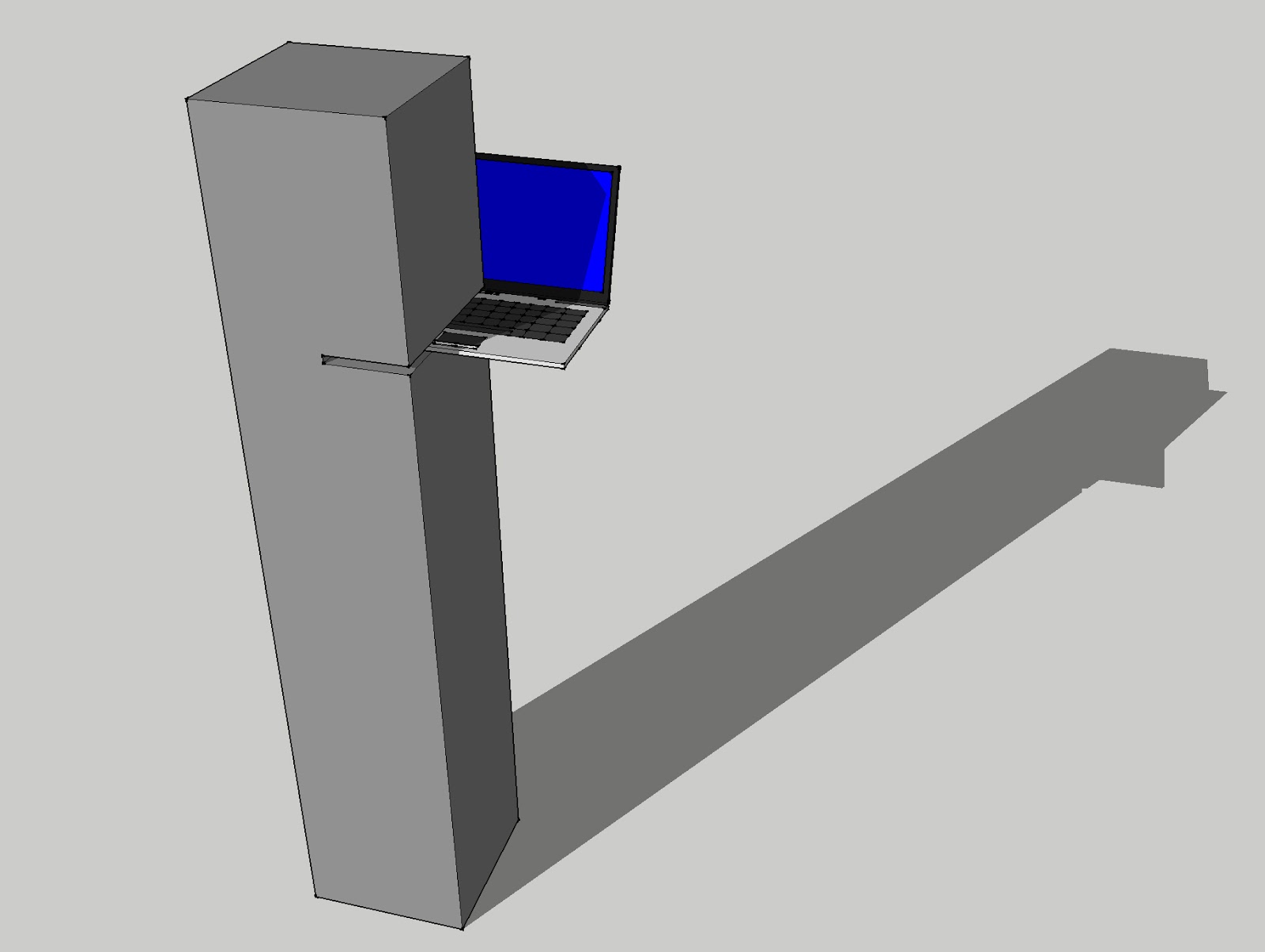
In other news, I’ve been carefully considering how I’m going to display the data that I’ve been amassing, with help from Google Sketchup. I began the process by considering what I actually wanted from the sculpture that I was going to immerse the stick within and started to research USB towers, which then led me to data towers and cell towers. The aesthetics of these structures and what they actually enable people to do was the main inspiration for my initial designs, where the laptops that connected to the USBs would create a cell tower-esque look.


As I continued to experiment though, I slowly began to change direction and returned to my love for the Monolith from 2001, which is eternally intriguing to me and conforms to the simple aesthetic that I had been pursuing with my earlier designs. I also began to be interested by the relationship that the (now multiple) USBs would be having with each other, and how the different screens of the laptops would be having a dialogue with one another if each USB was being connected to at once. The material for these ‘micro monoliths’ (three in total further referencing the three Monoliths in 2001) is something else that I’ve been considering. At first I envisioned them to be pure concrete, as I love the concrete plinth, but I slowly moved away from that, as it was revealed to me that I could use blocks that – at first – look like usual cement blocks but in reality are flammable and used in fires. The potential for a thing to happen really interested me, and I feel that that is reflected in the data that I’m collecting. Some of it may be harmful to others, in terms of embarrassing pictures or ‘confidential’ documents, but it’s not overtly being displayed, one has to dig deep into the files to discover these things. This duplicity really interests me and I hope to experiment in the real world during the coming week with the actual blocks, rather than simply through the virtual program. The use of brick also made me consider the famous relational artist Rirkrit Tiravanija and his brick making factory that was occurring in the 2015 Venice Biennale. Obviously the use of a construction material has certain connotations that (I feel) work well with the idea of amassing data within the virtual structure of the USB stick that’s been embedded within a brick.


Laila and I have also been in discussion this week and have laid out a kind of plan for the work that we’re going to create together, so that we can actually start making things rather than simply discussing what we want to create. At the moment it all sounds really exciting, I just need to actually start creating on my computer, which I hope to start doing during the week ahead. I also helped Laila set up her own website this week: http://www.lailamajid.com/. It’s still a work-in-progress however, so bare that in mind.

Oh and I continue to document the lighter ‘jacking’.
I had my third Utopia seminar on Monday, which began with a short clip from Star Trek: The Next Generation, one of the few ‘positive’ utopias that is portrayed in the media. Nearly every other film/book envisions that the world turns into a dusty wasteland when capitalism dies, an incredibly overt form of propaganda. We were then taken through the differences between a Utopia and a Dystopia with multiple literary and film references, finishing up with an episode from the beloved Twilight Zone which looked at a dystopia where people who had no use anymore were deemed ‘obsolete’ and put to death. Unfortunately that was my last Utopia seminar, as tomorrow morning there is a talk being hosted at Chelsea being given by Dan Ward and Francis Brady (the two people who ran my workshops last week) titled ‘What is post-digital art?’ The unfortunate thing is that the two events clash, and I’m a lot more inclined to go to a talk discussing digital art than a seminar on Utopia. Both are great but only one can prevail.

I didn’t have my other seminar this week that focuses on politics and art, as it was postponed and relocated to the end of this coming week, so that on Friday I will have two seminars back to back. This will be an extremely absorbing day I’m sure.

The offsite shows were also discussed further this week, with many exciting spaces being brought up as well as what links our work together in our exhibition group, a general underlying theme. I’m looking forward to how it develops into something more in the coming weeks.

I’ve also been travelling on a lot of night buses recently and have been thinking about how one gets to know a space and how your views of a location traverse and distort the more you understand its intricacies. The wonder that I once had for London and have mentioned before in this blog is slowly dying. To revert back to a time when my brother and I would play on an Etch A Sketch whilst being in awe of the lights coming from the mass of buildings as our car slowly glided into London would be a compelling intervention to how I see things now. Getting back into that head space would be bliss for a time…

During the week I went to a really enticing evening at Toynbee Studios that was being hosted by the artists Larry Achiampong and David Blandy. They showed a number of artist films that influenced and inspired them which culminated in Finding Fanon 2, a collaborative film created by the two of them that uses the Grand Theft Auto 5 in-game video editor. I love the film and enjoyed the discussion that occurred afterwards which was centred on the connotations of using the video game as a medium to create work, something that I have considered in past work and continue to think about.

I only went to one exhibition this week, which was at Vilma Gold. Julia Wachtel had some work being shown, which I’d kind of already seen at the Saatchi, large scale paintings with juxtaposing images. I’m not entirely opposed to these. Genoveva Filipovic also had work on show, full of little details that would seem unconscious if it weren’t in a gallery space. I really liked her work and all the different connotations that were being brought up.

The really annoying thing that happened this week was the revelation that both myself and Laila had gotten into San Francisco for Erasmus, but the university there was in fact not even taking anyone from Chelsea this year. So I was left with my ‘backup’ choice which was a university in Holland near Amsterdam. I declined however, as I would prefer to stay in London.

I also got to go around the Palace of Westminster on a sort-of tour. It was a mixture of dullness and interestingness rolled into one. An intriguing point was brought up that focused on the amount of ‘experts’ (200 (ish) in total) on hand for the various Lords to call upon if they needed information on one thing or another. Such a large amount of knowledge just a phone call away, on in the case of the internet, a simple click.

I’ve watched a variety of films this week, focusing more on the documentary side of things in relation to the internet and all that it has to offer. The first on the list was Deep Web, exploring the depths of the internet and highlighting that only a small amount of the deep web is the dark web. We Steal Secrets: The Story of WikiLeaks was another exciting one, and the fourth or fifth film that I’ve watched that’s focused on Julian Assange, which makes it even more evident how important he is in the grand scheme of things. Atari: Game Over was also enticing, deconstructing the legend of the buried E.T. video game and exploring Atari as a company. Ready Player One by Ernest Cline continues to come up a lot in the documentaries about video games that I’ve been watching. It’s a book that I read a few years ago, which focuses on the residents of a world that live out their existence in a virtual universe called the OASIS. I feel that it’s becoming increasingly relevant to the themes that I’m looking at within my own work, virtual realities and the like. The Rise and Rise of Bitcoin was another exciting one that was definitely worth watching, alongside We Live in Public which was incredibly disturbing at times, well, a lot of the time. It definitely reminded me of The Circle and how distressing that was to read towards the end, as well as The Prisoner with its overt surveillance and confinement. The idea that ‘big brother’ is the collective conscience rather than a sole person is one that was brought up a lot. 2010 is another film that I watched, which really didn’t live up to 2001: A Space Odyssey. Outland was an enjoyable experience; you can’t really go wrong with Sean Connery and his beautiful voice. The Birds, a film that I am embarrassed to say I hadn’t seen until this week, was incredible. The playground scene in particular was quite awesome and a definite favourite of mine. I also watched Rock the Kasbah, which was just weird, part of it was terribly racist and another part was very sincere. As the credits roll it’s revealed that the film is dedicated to a real person and that the film is based on a true story. Just too weird. Détective was another weird one that was hard to understand and that I find hard to talk about. The final film was Blade Runner at the IMAX, which was incredible as usual.

On top of watching these films, I also played episode 5 of Life is Strange, which is something I’ve been looking forward to for a while now. It was quite a beautiful end to the series but failed to fully take into account all of the decisions that you made in the first four episodes, which is a problem that many story driven games encounter, like Mass Effect 3 or any of Telltale’s games. The lack of gameplay was another disappointing aspect to the episode, with the first 30 minutes or so basically being an extended cut scene. Playing it also brought me back into the mind-set that I was in when I played it last, during the summer holidays last year, a transitional time for me in terms of moving away from home, etc. It was an interesting reflective moment which made the finale even more poignant than it already was. The long bus journey back to my room at 4:30 in the morning gave me a chance to further reflect on the events that had just taken place in front of my eyes, eventually coming to the conclusion that the game epitomises what I love about video games and the potential that the medium has. The last thing to note is the hilarious scene in an art gallery, where you can walk past groups of people discussing the ‘art’ on the walls. The whole game had such a Twin Peaks ‘vibe’ too which is never a bad thing.

I’m also slowly making my way through Jason Rohrer’s various video game worlds that he’s created, all of which are inspiring and thought provoking in their own subtle ways.

Oh and I also found out this week that someone had written about my work in their blog here: http://www.gamescenes.org/2016/01/game-art-bob-bicknell-knights-endless-confinement-2015.html which was an exciting revelation.

Plus, I finished Love, which had a slightly stressful ending and then proceeded to watch the first two episodes of Better Call Saul from season 2, which were very good.

In the next week I want to continue to create the canvas images, analysing the print that’s arriving tomorrow to see whether or not I need to order from a different website, etc. I also want to start experimenting in real life with the layout of the data blocks as well as gaining more and more data from different individuals. On top of this I intend to start actual work on the collaboration with Laila, so that we have something to show for the thoughts that we’ve been thinking about.

Snapchat:
bob.bk
Instagram:
bob.bk1

Sunday, 21 February 2016

Neoliberal Lulz, Love and Breathless

This week’s been full of really interesting workshops, enticing films and unfortunately not a lot of progression within my actual practice, which I’m surprisingly okay with because of how good the week of workshops was.

The first workshop that I encountered was very much centred on Hito Steyerl (which is never a bad thing), watching a few of her films and discussing what they were about and the positives and negatives of her career. A few of us also showed some of our work for a type of crit, gaining some more feedback on my most recent video piece along with seeing other people’s work who I may not have previously seen from the course, which is always fun. There was also a lot of discussion surrounding Chelsea as a university going on and it was intriguing to hear someone’s thoughts on the course who has actually been on the course, as opposed to a tutor or someone in second or third year.

My second workshop was also really exciting, considering lots of digital work and the idea of the game and play. I especially liked the idea of statistical storytelling and bringing an idea down to a human sized thing, rather than the whole picture; consuming an idea or concept in small increments. This made me think back to how artists are a bit like individuals at a ‘salad bar’, picking and choosing very particular things that are especially inviting to them and eating/learning this very specific subject, simply knowing a lot about a very niche thing.

This workshop also brought me back into thinking about the idea of the computer file and how to visualise the data that’s been collated over time on someone’s device. For part of the workshop we were tasked to create a relational piece of art work, a work that the viewer can actually be a part of and create with the artist, (in a sense) collaborating with the artist to create the ‘finished’ piece. For this I had the idea to bring a memory stick to the workshop and ask people to give me some of their files from their computer. This was considering some of the ideas from my last project (governments stealing your data, etc) but subverting it slightly, asking rather than taking, thinking about the idea of the ‘small-print’ being not so small and converting the taking of data into a real life event rather than a virtual one. It also stemmed from the famous quote by Isaac Newton ‘If I have seen further, it is by standing on the shoulders of giants’ which made me think a lot about the idea of appropriation and the mixture of artists that do so.

After doing this for the workshop however, I started to consider it further and expand on the initial idea. As the week continued I started to plug my external hard drive into other people’s computers to effectively steal their data without them knowing, bypassing the asking part of the original idea. I envision the finished product as a USB stick with all of the data within simply embedded into a very weighty object, thus representing the weight of the data, with it being accessed/added to by anyone who wanted to be a part of the work and share whatever they had on their electronic device.

On top of this I was considering fantasy exhibition ideas, where a given room would only have USB sticks embedded within the wall (reminiscent of ‘dead drops’) with the images/videos on the sticks being accessible only if you had a laptop with you, or if a laptop was provided to you by the gallery, etc. Just as an idea, this is incredibly inviting, and is something I want to pursue further in the future. I realise that to work with a USB stick, or any type of technology in general, immediately makes the work about (or at least in part) the obsoleteness of the medium in five or even a few years’ time. I think that this is something that I accept within my work though, and embrace the fact that people may not be able to access the files in however many years’ time. It just adds to the seclusion that occurs when people don’t have a laptop on them to read the files as of right now.

This week I’ve also been continuing my work surrounding search engines, which is slowly turning into something that I’m very excited about. The concept thus far is to create a series of images that appear to be screengrabs of my computer screen. A multitude of things will be occurring within the image, bringing up several concepts surrounding the search engine in relation to location/internet security as well as the ‘multitasking’ society that we all live in. I plan to have these images printed onto canvas through the internet, which will pose many questions surrounding whether or not using the internet for everything is the correct way to live one’s life as I suspect that the canvas will be of a low quality. This will also be considered by showing open web pages centred on how to achieve the best composition or aspects of image creation like the rule of thirds. Making the image into a painting of sorts also accomplishes my want to create a real thing, rather than simply a screen based work. I see the images below as a starting point, a means to an end, or the beginnings of an enticing idea. I’ve also thought about the use of a lightbox within the piece, similar to Timur Si-Qin’s work that I saw at the White Cube last week.


I’ve also continued to take photographs of the ‘jacked’ lighters, which will be an ongoing project that will finish once I feel that a sufficient number of images have been created. I’m sure there will be a relevance to the number of pictures, as well as the fact that they’re all portrait shots that were taken using an IPhone.

At the beginning of the week there was a mini symposium which was focused on how artists gain their ideas, primarily discussing how ‘getting lost’ is a very important part of the process. It was more interesting than inspiring to me.

There was also an artist talk by Zachary Fabri which was fairly enjoyable. I was a big fan of one of his works titled Target Customer Relations which focused on Fabri wandering around a Target whilst wearing the employee clothing in order to have conversations with customers surrounding the death of ‘mom and pop’ stores. I enjoyed it.

I also went to a few exhibitions, including Neoliberal Lulz at Carrol Fletcher which was simply awesome, featuring DullTech™ and Jennifer Lyn Morone™ Inc. It’s hard to express how much I enjoyed the exhibition, so I’m not even going to try. I thoroughly recommend that you go and see for yourself with your own eyes. Another great exhibition (Feeling In The Eyes) at Tenderpixel was focussed on the idea of materiality in relation to the internet among other things. The use of a motion sensor attached to a light was particularly impressive, as well as all the video pieces with the second screen experiences.

The less interesting exhibitions included Performing for the Camera at the Tate, which was full of really cool images that we’ve all seen before, Yves Klein’s Anthropometries and Erwin Wurm’s One Minute Sculptures, etc. Pi Artworks was distressingly dull and filled with drawings, Blain Southern had some fancy bronze work which was unexciting and going to Sprüth Magers was like going back in time to the 80s, which is usually a good idea, but in this case it was not. Maddox Arts was kind of okay, with lots of paper folding and sewing pieces but compared to Carrol Fletcher the whole experience paled in comparison. The final two galleries of the week were the two Gagosian galleries, which had terrible paintings on display, which is never exciting. I can appreciate when paintings are actually aesthetically pleasing, but these weren’t even that, they were just shit and dull.

Also, I managed to watch about three hours of #ELEVATE on Friday, and I’m still wondering whether it was a waste of my time or not.

In other news, I finished watching Girls, which was surprisingly enjoyable as I was slowly sucked into their ‘complicated’ lives. I really liked how the whole program was filmed, how the camera would observe the women in their underwear was incredibly unique, in a very non-judgemental/un-perverted way. I then began to watch Love which, for a Judd Apatow creation, is actually pretty great. I really like how, in both of these programs, the conversations are very realistic in their manner, with the dialogue being a definite high point.

I’ve also been watching a number of films, including Breathless (which was quite beautiful in a disjointed way), Manglehorn (worth watching simply for one scene featuring a cat and watermelons), The Andromeda Strain (the decontamination process was incredible alongside some really interesting camera techniques), We Are Legion: The Story of the Hacktivists (reaffirming what I basically already knew about Anonymous), GTFO: Get the F&#% Out (looking at the hardships that women go up against in the world of video games, something that I’m already aware of but still incredibly distressing to see), Zoolander 2 (disappointing and boring, doubly disappointing as I love the first one so much), Boogie Nights (amazing to see it in the cinema rather than on my laptop screen, such a beautiful classic), Deadpool (some funny moments, all worth it for the after credits scene), Castle in the Sky (more awesomeness from Miyazaki) and The Survivalist (quite an impressive first feature film by Stephen Fingleton).

I’ve been listening to quite an enticing podcast for the last couple of weeks called Farstuff: The Internet of Things which has been riveting, discussions surrounding what it means to be human and drone usage turning countries into a police state are some of my favourite topics so far.

During this week ahead I plan to continue to collect people’s data and begin to think about what material/object I want to sink the USB stick into. On top of this I also want to finish and send off one of the desktop images to be printed, as it will take at least a week to actually arrive after I order it. I’m also going to see Blade Runner at the IMAX on Friday which should be an exhilarating experience and one that I’m very much looking forward to.

Oh and Laila and I still haven’t progressed any further with our collaboration, which is very disappointing.

Snapchat:
bob.bk